
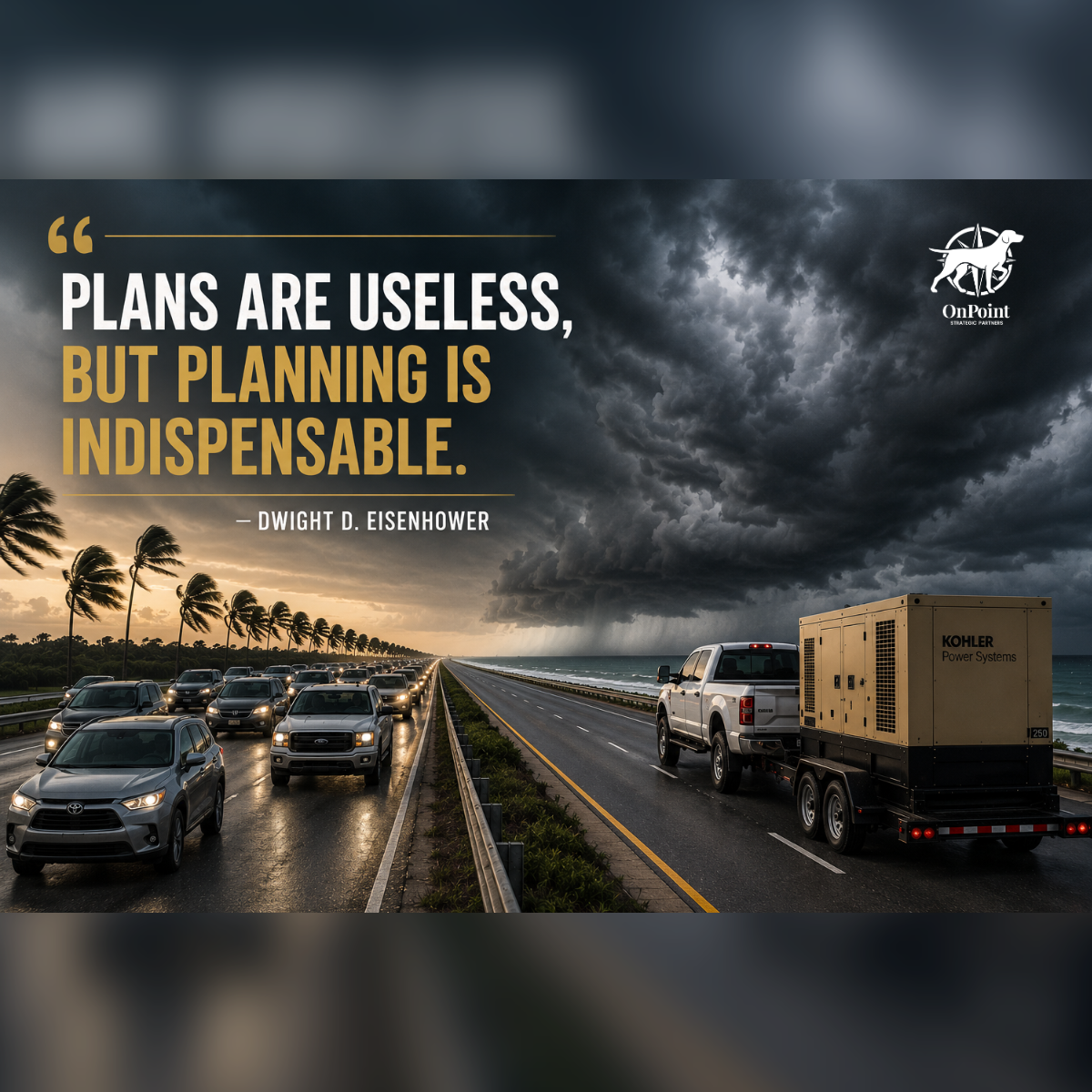
Thank you to everyone who joined this month’s CoreBuild™ Collective discussion. As hurricane season ramps up, the conversation focused on emergency preparedness, business continuity, and what it really takes to keep organizations operating when disaster strikes.
As Dwight D. Eisenhower put it, “Plans are useless, but planning is indispensable.” The point was not to abandon planning. It was to recognize that no plan survives first contact with reality. Storms are predictable. Their exact path, intensity, and impact are not. That’s why the strongest Facilities leaders don’t measure preparedness by the binder sitting on the shelf. They measure it by their ability to adapt.
Emergency preparedness is not about having a plan. It is about building an organization capable of responding when the plan inevitably needs to change.
From this month’s CoreBuild™ Collective
Top takeaways
Build vendor relationships before you need them. The time to find a reliable partner is long before a storm forms, not while one is bearing down.
Establish communication and escalation plans early. Clear lines for who is contacted, and in what order, prevent confusion when conditions change quickly.
Know your critical assets and operational priorities. Understanding what has to stay running, and in what sequence, focuses the response when resources are stretched.
Coordinate across the whole organization. Facilities, Operations, Real Estate, Procurement, Legal, and Executive Leadership each have a role, and preparedness works best when they plan together rather than in silos.
Learn from every event. Each storm, outage, or near miss is a chance to strengthen the next response.
Adaptability beats the binder. The organizations that recover fastest are not always the ones with the most detailed plan. They are the ones with the strongest partnerships, the clearest communication, and teams empowered to make informed decisions as conditions change.
The group also explored
- Pre-season readiness timelines and drills
- Backup power and other critical systems
- Communication trees and escalation paths
- Documentation, insurance, and recovery
- Supply chain and materials staging
- Keeping executive leadership informed during a crisis
A note for supplier partners
For service providers, emergency preparedness is where the strongest partnerships prove their value. The best partners help clients:
- Prepare and vet support before the season starts
- Communicate clearly and respond fast when conditions change
- Protect critical assets and operations
- Debrief and improve after every event
The suppliers who show up as continuity partners, not just storm-season vendors, are the ones FM leaders remember.
We’re continuing to thoughtfully expand the group with strong FM leaders across healthcare, restaurants, retail, education, and service-based industries.
That’s the kind of conversation happening inside the CoreBuild™ Collective. If you’re a multi-site FM leader who wants in, fill out the form on the CoreBuild Collective page.